
Pode usar um 401(k) ou IRA para financiar um Golden Visa em Portugal?

If you’re American and looking at the Golden Visa, you’ve probably run into a version of this pitch. Roll your 401(k) or IRA into a self-directed IRA, subscribe to a qualifying Portuguese fund from inside the account, and you get EU residency without liquidating your savings or paying tax to free up the money.
You can see why it sells. Most Americans hold the bulk of their net worth inside retirement accounts. Finding 500,000 euros of liquid, already-taxed cash is hard. Finding it inside a 401(k) is much easier. For plenty of people this looks like the only route that works.
So read the rule that decides it. The actual wording, not somebody’s summary of it.
What the Portuguese regulation actually says
The Golden Visa is governed by Portugal’s immigration law and by Decreto Regulamentar 84/2007, which sets out the detail. Article 65-A of that decree covers the investment requirements. Paragraph 7 is the one that matters here:

“”Os investimentos previstos na alínea d) do artigo 3.º da Lei n.º 23/2007, de 4 de julho, na sua redação atual, podem ser realizados individualmente ou através de sociedade unipessoal por quotas de que seja sócio o requerente.””
The investments may be made individually, or through a single-shareholder quota company of which the applicant is the shareholder.
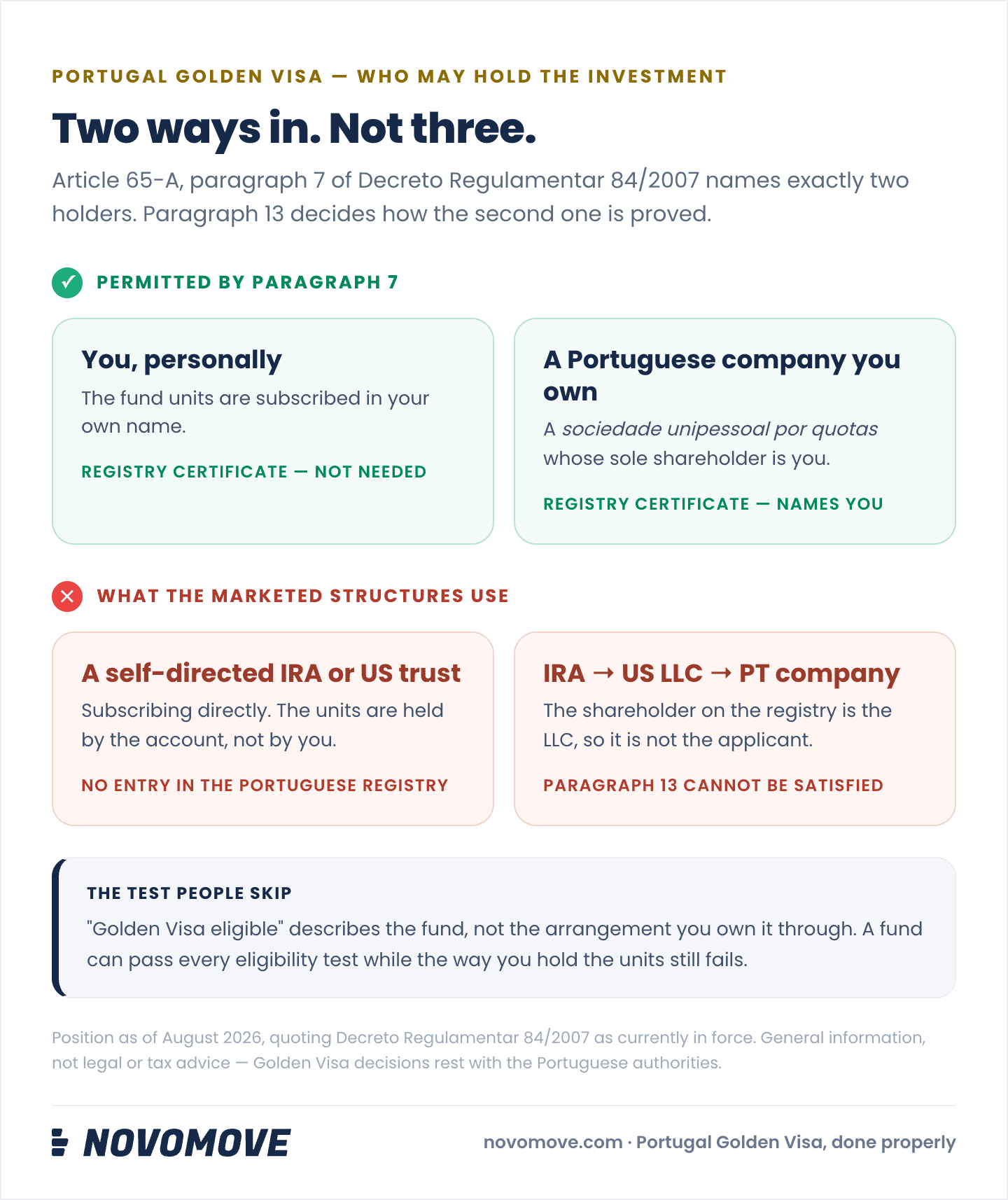
Two ways. You hold it yourself, or you hold it through a Portuguese sociedade unipessoal por quotas that you are the shareholder of. There is no third option in the article.
Paragraph 13 then sets out how the company route is proved:
“Sempre que os investimentos previstos no n.º 7 sejam realizados através de sociedade unipessoal por quotas, deve o requerente da concessão ou renovação de autorização de residência apresentar certidão do registo comercial atualizada, que demonstre ser o requerente o sócio da sociedade unipessoal por quotas.”
Where the investment is made through a single-shareholder quota company, the applicant must produce an updated Portuguese commercial registry certificate showing that the applicant is the shareholder. This applies both when the permit is granted and when it is renewed.
That second paragraph is the practical barrier. The company route is evidenced by a document from the Portuguese commercial registry naming you. A US trust, a US LLC and a self-directed IRA custodian have no entry in that registry and cannot obtain that certificate. The regulation offers no alternative document for a foreign entity.
You’ll find articles saying the investment can be held through a single-shareholder company based in Portugal or another EU member state. That was true once. The paragraph containing the registered-office rule was revoked by Decreto Regulamentar 9/2018.
If a page you’re reading still cites it, that page is working from a version of the law that hasn’t been in force since 2018.
Where the structures on offer run into it
Two arrangements get marketed. They fail in different places.
Direct subscription from the retirement account
Some funds accept a subscription straight from a self-directed IRA or a trust set up for it. The participation units are then registered to the account or the trust. One firm promoting this describes it plainly as a feature: the funds are held under the IRA name, not your personal name.
Read that against paragraph 7. Units held by a retirement account are not held by you individually, and a US trust is not a sociedade unipessoal por quotas. There is also a documentation problem downstream. A Golden Visa file needs a declaration from the fund confirming ownership of the units and a declaration from a Portuguese bank confirming the transfer of capital into Portugal. If the subscriber and the sender are a US entity, that’s the name those documents carry.
The chain: retirement account, US LLC, Portuguese company, fund
The more elaborate version tries to solve exactly this. The retirement account funds a US LLC, the LLC funds a Portuguese company, and the Portuguese company subscribes to the fund. Now there’s a Portuguese company in the chain, so on paper you’re inside the second option in paragraph 7.
Holds the money. Controlled by a US custodian, not by you directly.
Owned by the account. Exists to move the money onward.
Subscribes to the fund. Its shareholder is the LLC, not you.
The registry certificate has to name the applicant as the shareholder. With the LLC in that slot, no such certificate exists.
Paragraph 7 doesn’t just require a Portuguese company. It requires one de que seja sócio o requerente, of which the applicant is the shareholder. And paragraph 13 requires a registry certificate proving it. If the US LLC owns the Portuguese company, the applicant isn’t the shareholder and no such certificate exists.
Which leaves owning the Portuguese company personally. That produces the certificate. It also means retirement account money has bought an asset registered in your own name, which is the point at which the question stops being Portuguese and becomes American.
| Who holds the fund units | Permitted by paragraph 7? | Registry certificate (paragraph 13) | Where it lands |
|---|---|---|---|
| You, personally | Yes, the first option | Não é necessário | The standard route. This is how approved applications are structured. |
| A Portuguese sociedade unipessoal por quotas you own | Yes, the second option | Available, and it names you | Works under Portuguese law. If retirement money bought the company, the question moves to the US side. |
| A self-directed IRA or US trust, subscribing directly | No. Neither option covers it | Impossible. No entry in the Portuguese registry | The units are held by the account, not by you. |
| Retirement account, then US LLC, then Portuguese company | Only if the company is yours, not the LLC’s | Only if you are the registered shareholder | Circles back to the row above, with the US question attached. |
The American side
We’re a relocation platform, not a US tax advisor, and nothing here is advice on your tax position. But know three things before any money moves.
US law restricts transactions that produce a personal benefit from retirement account assets. The rule is Internal Revenue Code section 4975, and the definition of benefit is not limited to money.
Authority to interpret that section does not sit with the IRS. Under Presidential Reorganization Plan No. 4 of 1978 it was transferred to the Department of Labor, and Treasury is bound by the Labor Department’s interpretations. This matters because people are sometimes told to get an IRS ruling to validate the structure. That’s the wrong instrument from the wrong agency, and an expensive one: the standard user fee for a private letter ruling is currently $43,700, up from $38,000 in early 2025, with reduced tiers for lower incomes. Articles still quoting the old figure are out of date. Where certainty is needed, the route is a Department of Labor advisory opinion or an individual prohibited transaction exemption, and an exemption application has to show the transaction is in the interests of the plan and its beneficiaries, published in the Federal Register, with a public hearing where self-dealing is in issue.
A refused visa application costs you a government fee. Where a transaction is found to be prohibited, the account can be treated as fully distributed. That one costs you the account.
None of this happens out of sight, either. Portugal reports financial account information on US persons to the IRS under FATCA, so a fund subscription or a bank account tied to an American shows up automatically.

Whether a Golden Visa investment falls inside that rule is a genuine legal question with real arguments on both sides, and it is not ours to answer. What we can tell you is that we searched for a published IRS or Department of Labor ruling approving one of these structures and found none, and that we found no documented case of an approved Portuguese residence permit where the investment was held through a US retirement account. Firms marketing the route make claims about the fund. None that we found makes a claim about an approved permit.
Who else has looked at this
Two people have published proper analyses of this. Neither is selling a fund. Read both in full.
Zeev Fisher, writing at Fresh Legal, takes the firmer line. His view is that a Golden Visa investment opens the door to residency, that this is a personal benefit and in fact the primary reason for the investment, and that a US regulator would treat an investment made from a retirement account as a prohibited transaction. He describes the layered structure promoters typically build, notes that some funds accept a direct subscription without it, and advises avoiding funds and fund managers that offer the option unless they can produce a US government ruling supporting the structure they propose. He also points out that the penalty for getting it wrong can run to the whole account.
Derren Joseph of HTJ Tax is more cautious than categorical, and covers the US international tax angle. He raises the same central question, whether benefitting from residency or eventually citizenship can be viewed as self-dealing, alongside uncertainty about how the entity is named, how PFIC rules flow through, and what foreign reporting applies. His conclusion is that there’s no specific IRS guidance on the question and that anyone considering it should get a written legal opinion before proceeding.
We’re pointing you to both because they’re the only published analyses we found that take the American side seriously rather than treating it as a formality. Neither is our advice to you, and neither replaces speaking to your own counsel about your own situation.
If you actually move to Portugal
There’s a Portuguese layer people skip past. If you later become a Portuguese tax resident, Portugal taxes you under its own rules, and it does not treat US retirement wrappers the way the US does.
Most Golden Visa holders never trigger this, since the permit only requires an average of seven days a year in the country. But if moving here is part of your plan, how Portugal will see your retirement accounts is a question to put to a consulta fiscal before you structure anything, not after.
The phrase that does a lot of work
Almost every article on this describes the fund as Golden Visa eligible, and usually that’s accurate. Fund eligibility has its own test: registered with the CMVM, constituted under Portuguese law, a maturity of at least five years at the time of investment, at least 60% of the investment value placed in commercial companies based in Portugal, and no real estate.
A fund can pass every one of those and the way you hold the units can still fail. They are separate questions with separate answers. Golden Visa eligible describes the fund. It says nothing about whether the arrangement you own it through qualifies you for the permit. Keep the two apart when you read the marketing.
What actually works
The honest version is slower and costs more, and it survives scrutiny on both sides of the Atlantic.
Free up the funds first. Work out the tax consequences with your own US advisor, because sequencing a liquidation well can make a real difference to what you pay. Then transfer the money to Portugal from your own account, in your own name.
It should show you as the sender. Transfers arriving from a joint account with two names on it cause problems with the bank declaration later, because the declaration carries whatever names the wire carried.
Fixing it takes an explanatory letter from you, a declaration from the other account holder confirming they have no economic interest in the investment, and a confirmation from the fund. All of it avoidable by sending from an account in your name only.
We don’t arrange or facilitate Golden Visa investments funded from US retirement accounts, and we won’t introduce you to anyone who does.
If you want to pursue it anyway, take it to a US attorney who specialises in employee benefits and retirement plans. Not to a fund manager, whose interest in the answer is not neutral, and not to us.
If you’re weighing this up
Ask anyone recommending the structure two questions. Which paragraph of the Portuguese regulation permits it. And can they point to an approved residence permit where the investment was held this way, rather than to a fund that accepts the subscription.
Both are fair questions and both have short answers. How they respond will tell you most of what you need to know.

If your money is sitting in retirement accounts and you’re trying to work out whether the Golden Visa is realistic for you, that’s a solvable problem, just not by the route above. It’s usually a sequencing and tax-planning question, best had early, before you’ve committed to anything. A paid consultation with our partner immigration lawyer is there for anything that needs legal detail.
Perguntas frequentes
Can I use my 401(k) or IRA to get a Portugal Golden Visa?
Portuguese law says the qualifying investment may be made in one of two ways: by you personally, or through a Portuguese sociedade unipessoal por quotas of which you are the shareholder. A US retirement account, a US trust and a US LLC are none of those. Several firms market structures that route retirement money into Golden Visa funds, but we have not found a published case of an approved residence permit where the investment was held that way.
What does Portuguese law say about who holds the investment?
Article 65-A, paragraph 7 of Decreto Regulamentar 84/2007 states that the investments may be made individually or through a sociedade unipessoal por quotas of which the applicant is the shareholder. Paragraph 13 requires an updated Portuguese commercial registry certificate proving the applicant is that shareholder, at both grant and renewal.
Doesn’t the law allow investing through an EU company?
It used to. An earlier version of the rule allowed a single-shareholder company with its registered office in Portugal or another EU member state and a permanent establishment in Portugal. That paragraph was revoked by Decreto Regulamentar 9/2018. Articles still citing the EU registered-office rule are quoting a version that hasn’t been in force since 2018.
If a fund is Golden Visa eligible, doesn’t that mean the structure works?
No. Fund eligibility and holding structure are two separate tests. A fund can be perfectly eligible (CMVM registered, five-year maturity, at least 60% invested in companies based in Portugal, no real estate) while the way you hold the units still fails. The phrase describes the fund, not the arrangement you own it through.
What is the US-side risk of investing retirement money this way?
US law restricts transactions that provide a personal benefit from retirement account assets, under Internal Revenue Code section 4975. Authority to interpret that section sits with the Department of Labor rather than the IRS, under Presidential Reorganization Plan No. 4 of 1978. Where a transaction is found to be prohibited, an IRA can be treated as fully distributed. Whether a Golden Visa investment falls within that rule is a question for your own US counsel, and we don’t advise on it.
So how do Americans actually fund the 500,000 euros?
Free up the funds first, plan the tax with your own advisor, then transfer the money to Portugal from your own account, in your own name. Portuguese banks require proof that the full amount is already available before the account is opened, so gradual accumulation doesn’t work. That sequencing is usually what needs solving, not the structure. A consulta fiscal is the right place to start on the Portuguese side.
Does Novomove help with retirement-account Golden Visa structures?
No. We don’t arrange, facilitate or introduce clients to structures that route retirement money into a Golden Visa investment. If you want to explore it, take it to a US attorney who specialises in employee benefits and retirement plans.
This route has been promoted since 2024. Doesn’t that make it established?
Time on the market is not approval. What has accumulated since 2024 is marketing, subscriptions and structures, not published rulings or documented residence permits held this way. The tests haven’t moved: paragraph 7 on the Portuguese side, section 4975 on the American side, and neither has been ruled on. An untested structure that is two years old is still untested.
Could the rules change?
They have changed repeatedly. Real estate was removed as a qualifying investment in 2023, and the registered-office rule for company holdings was revoked in 2018. Anything you read on this subject should be checked against the date it was written and the version of the regulation in force now.
Fontes
This article reflects the position as of August 2026 and quotes the Portuguese regulation as currently in force. Rules change. Check the date on anything you read on this subject, including this page.
- Decreto Regulamentar n.º 84/2007, de 5 de novembro, artigo 65.º-A, consolidated text. Procuradoria-Geral Distrital de Lisboa: pgdlisboa.pt
- Decreto Regulamentar n.º 9/2018, de 11 de setembro, Diário da República, 1.ª série, n.º 175 (current wording of paragraph 7; revocation of the registered-office paragraph): files.diariodarepublica.pt
- Decreto Regulamentar n.º 1/2024, de 17 de janeiro, Diário da República, 1.ª série, n.º 12 (current wording of paragraphs 12 and 13): official gazette PDF
- Lei n.º 23/2007, de 4 de julho (as amended), artigo 3.º n.º 1 alínea d) and artigo 90.º-A: diariodarepublica.pt
- AIMA, Autorização de Residência para Investimento (art. 90.º-A): aima.gov.pt
- Zeev Fisher, Fresh Legal, “Guide for Americans investing in Portugal’s Golden Visa”: fresh-legal.com
- Derren Joseph, HTJ Tax, “Using US retirement funds to invest in Golden Visa funds”, March 2025: htj.tax
- US Department of Labor, EBSA, advisory opinion on Internal Revenue Code section 4975 (transfer of interpretive authority under Reorganization Plan No. 4 of 1978): dol.gov
- US Department of Labor, procedures governing prohibited transaction exemption applications, Federal Register, 24 January 2024: federalregister.gov
- IRS, Revenue Procedure 2026-1 (letter ruling procedures and user fee schedule, Appendix A): irs.gov
Novomove is a technology platform that coordinates licensed Portuguese lawyers and other professionals. We are not a law firm, we are not tax advisors, and this article is general information rather than legal or tax advice. It describes Portuguese regulation as published and US law as published; it does not tell you what either means for your situation. Golden Visa decisions are made by the Portuguese authorities. For advice on your own case, speak to our partner immigration lawyer in Portugal and, on anything touching a US retirement account, to your own qualified US counsel.