Portugal D2 Visa: Register as a Freelancer First?

One checklist tells you to be registered with the Portuguese tax office and issuing recibos verdes before you apply. Another says a service contract with a Portuguese client is all you need at the visa stage, and the registration comes later. Both sound official. Only one fits where you are in the process.
Here’s the short version, then the detail.
The short answer
No. You don’t need to open your freelance activity with Finanças (abertura de atividade, the step that lets you issue recibos verdes) before you apply for the D2 visa at the consulate.
At the visa stage, what carries your file is a service contract with a Portuguese client, or a written proposal for one. The activity registration happens after you arrive in Portugal, when you apply for your residence permit at AIMA.
The reason people get told otherwise is simple. The D2 has two separate stages, and the registration belongs to the second one, not the first. Mix the stages up and you end up doing tax admin months too early.
Why the D2 has two stages, and why it matters
The D2 isn’t one application. It’s two, in two different places.
Stage one: the residence visa

You apply at the Portuguese consulate or VFS centre in your country of nationality or legal residence. You can’t do this from inside Portugal. At this point you’re a non-resident. The visa is what lets you enter Portugal and then apply for residency.
Stage two: the residence permit
Once you’re in Portugal, you book an appointment with AIMA (the immigration authority) and apply for your residence permit. This is where you become a resident, and it’s where your tax and social security registration comes into the picture.
Different stage, different paperwork. A lot of the confusing advice online mixes the two, or mixes the freelance route up with the company-formation route, which has its own separate document set. Once you separate the stages, the answer is clear.
| Consulate stage (residence visa) | AIMA stage (residence permit) | |
|---|---|---|
| Where | Portuguese consulate or VFS in your country | AIMA office in Portugal, after you arrive |
| Your status | Non-resident | Becoming resident |
| Freelance registration (recibos verdes) | Not needed | Needed: open your atividade with Finanças and Social Security |
| Main purpose document | Service contract with a Portuguese client (or written proposal) | Proof you’ve opened your activity |
| Also needed | Financial minimum, accommodation, insurance, clean criminal record, NIF | Your visa, plus the standard permit documents |
What the consulate actually asks for on the freelance route
For the independent-professional route, the document that does the heavy lifting at the visa stage is your service agreement.
Portugal’s immigration law (Lei 23/2007, Article 60) sets out what an independent professional needs for the residence visa: a contract, or a written proposal for a contract, to provide services, plus proof you’re qualified to do the work where the profession is regulated. There’s no line requiring you to be registered with Finanças or issuing recibos verdes.
In practice, our network of licensed Portuguese immigration lawyers advises the strong version of this: a signed service contract of at least a year with a Portuguese client. A vague letter of intent is weaker than a proper contract, and the consulate is reading your file to decide whether your activity is real.
Alongside the contract, the visa stage needs the usual residence-visa documents: proof of enough money to support yourself (for 2026 that’s €11,040, which is twelve times the €920 Portuguese minimum wage, with more required if family come with you), somewhere to live, health insurance, and a clean criminal record. You’ll also need a NIF, and usually a Portuguese bank account. Getting a NIF isn’t the same as registering your activity, so don’t let anyone tell you it is.
When you actually register as a freelancer

The freelance registration, the abertura de atividade, happens after you land, as part of the AIMA stage.
Once you’re in Portugal and applying for your residence permit, you open your activity with Finanças and register with Social Security. That’s the point where you become able to issue recibos verdes and invoice as a Portuguese freelancer. AIMA’s own document list for the independent-professional permit asks for proof that you’ve started your activity with the tax office and social security, so this is the stage where the registration needs to exist.
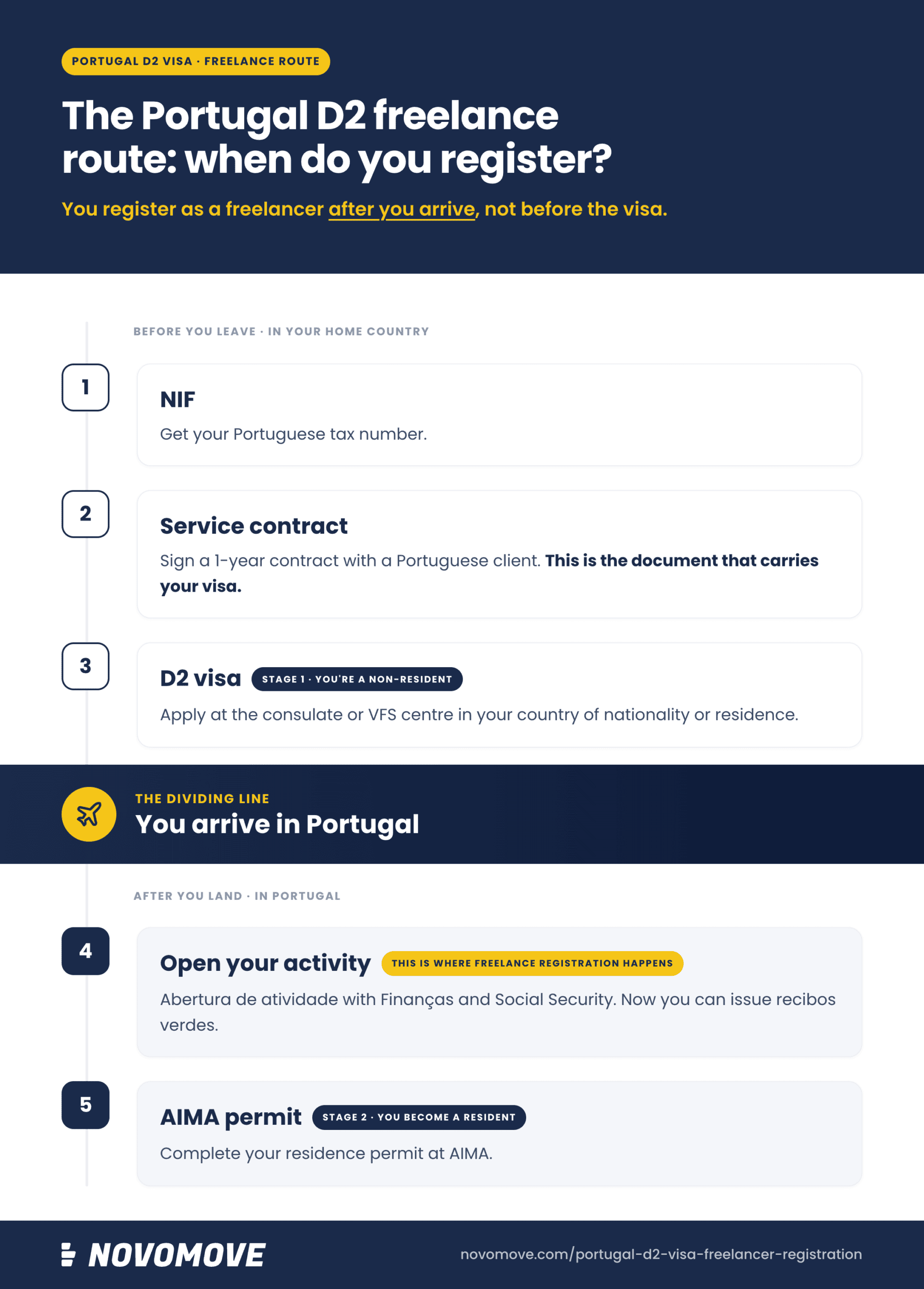
So the sequence for the freelance route runs like this: get your NIF, sign a service contract with a Portuguese client, apply for the visa, travel to Portugal, open your activity, then complete the residence permit at AIMA.
When you reach that point, you don’t have to work out the tax portal yourself. Our freelancer activity registration service has a partner accountant open your atividade on Portal das Finanças and set the right activity codes, with a written summary of what you’ll owe and when.
Can you register before you move? Technically yes, usually no

You can open your freelance activity as a non-resident, but there’s a catch worth understanding first.
The tax representative that comes with your NIF isn’t the one that opens your activity. A NIF tax representative is there to receive correspondence from Finanças on your behalf. It can’t open an activity or register your activity codes on the tax portal. For that, a non-EU resident has to appoint a separate VAT tax representative: a Portuguese accountant, registered for VAT, who takes on joint responsibility for your VAT and has to be in place before you start. That’s a different role with a different level of responsibility, and it comes with a monthly fee. EU and EEA residents have more flexibility here, but for US, UK and Canadian applicants the VAT representative is the rule. We explain the difference in full in this help article.
If you do need a VAT representative, you don’t have to go hunting for one. Reach out to us and we’ll recommend an accountant who’s ready to act as your VAT representative for a monthly fee.
On top of that, registering early switches on Portuguese tax admin before you’re actually living there. Since 1 July 2025, the small-business VAT exemption that keeps things simple for new freelancers is only for people established in Portugal. A non-resident who opens activity doesn’t get that exemption and follows the standard VAT regime from day one, regardless of turnover. Opening activity doesn’t by itself make you a Portuguese tax resident, but it does start filing obligations you’d otherwise avoid until you arrive.
There are edge cases where registering early makes sense, usually when a client needs you invoicing from day one. If that’s you, talk to us first so you go in knowing the tax side, the VAT representative and the cost, rather than finding out later.
What changed in October 2025
If you’re reading older guides, note that the rules tightened. Lei 61/2025 came into force on 23 October 2025 and removed the manifestação de interesse route, which used to let some people regularise from inside the country. A proper residence visa is now mandatory before you can get the AIMA permit.
For the freelance route, this didn’t add a tax-registration requirement at the visa stage. The service contract still carries the visa file. What it did do is make the visa itself non-optional, so getting stage one right matters more than it used to.
What this means if you’re applying
Keep it simple:
- Line up a real service contract with a Portuguese client, ideally for a year or more. This is the document that carries your visa.
- Get your NIF sorted. It’s needed for the contract, the bank and almost everything else, but it isn’t activity registration.
- Don’t rush to open your atividade before you leave. In most cases you register after you arrive, for the AIMA stage.
- If a specific consulate or a client pushes you to register early, get a partner accountant’s read on the tax side first.
One honest caveat. Consulates can and do ask for extra documents, and practice varies slightly between offices. The law and the official checklists point the same way on this, but your specific consulate’s current list is the one that governs your file. That’s exactly the kind of thing worth checking on a quick call before you start.
How Novomove helps with the D2

Novomove is a technology platform that coordinates licensed Portuguese lawyers and accountants for people moving to Portugal. We’re not a law firm. On the D2, our partner immigration lawyers handle the legal side and a partner accountant handles the tax registration when the time comes.
If you’re weighing the freelance route, our Portugal D2 visa support walks you through the contract, the dossier and the timing, with a dedicated case manager and a partner lawyer reviewing your file.
Not sure the freelance route is even the right one for you? Start with a free 15-minute call and we’ll point you the right way. If your case has real legal wrinkles, a paid consultation with a partner immigration lawyer gets you a straight answer before you commit documents or money.
Frequently asked questions
Do I need recibos verdes to apply for the D2 visa?
No. You don’t need to be issuing recibos verdes when you apply at the consulate. That comes after you arrive, when you open your activity with Finanças for the AIMA residence permit. At the visa stage, a service contract with a Portuguese client is what’s needed.
Is a service contract enough for the D2 freelance visa?
For the visa stage, yes. Portugal’s immigration law asks for a service contract, or a written proposal for one, plus proof you’re qualified where the profession is regulated. A signed contract of a year or more with a Portuguese client is the strong version.
Do I need a Portuguese client for the D2 freelance route?
Yes. The independent-professional route is built around providing services to a Portuguese entity, so you need a service agreement with a Portuguese client, not a foreign one. Freelancers whose income comes from foreign clients usually look at the D8 digital nomad visa instead.
When do I open my freelance activity (abertura de atividade) for the D2?
After you arrive in Portugal, as part of the AIMA residence-permit stage. That’s when you register with Finanças and Social Security and can start issuing recibos verdes.
Can I register as a freelancer before I move to Portugal?
Technically yes, but the tax representative that comes with your NIF can’t open an activity. As a non-EU resident you’d need a separate VAT tax representative, a Portuguese accountant who takes on joint VAT responsibility for a monthly fee. Since July 2025 the small-business VAT exemption is only for people established in Portugal, so a non-resident follows the standard VAT regime from day one. Most people register after they arrive. If you need to open earlier, reach out and we’ll recommend a VAT representative.
Can I apply for the D2 from inside Portugal?
No. The D2 visa is applied for at the Portuguese consulate in your country of nationality or legal residence. You then travel to Portugal and complete the residence-permit stage at AIMA.
Sources
This article reflects the position as of July 2026. Immigration law and consular checklists change, so treat the official links below as the current word and check the date on anything you read elsewhere.
- Portugal’s Immigration Law, Lei n.º 23/2007, de 4 de julho (as amended), Articles 60 and 89. Official legislation portal, Ministério dos Negócios Estrangeiros: vistos.mne.gov.pt/pt/vistos-nacionais/legislacao-nacional
- Decreto Regulamentar n.º 84/2007, de 5 de novembro. Diário da República: diariodarepublica.pt/dr/detalhe/decreto-regulamentar/84-2007-629434
- Residence-visa document requirements (documentação instrutória), Portuguese consular services: vistos.mne.gov.pt/pt/vistos-nacionais/documentacao-instrutoria/residencia
- Residence permit for independent professional activity, Article 89(1), AIMA: aima.gov.pt
- Example of a live consular checklist, Consulate General of Portugal in Toronto: toronto.consuladoportugal.mne.gov.pt
- Appointing a fiscal representative (Nomear representante fiscal), gov.pt: gov.pt/servicos/nomear-representante-fiscal
- End of the manifestação de interesse route: Lei n.º 61/2025, de 22 de outubro, in force 23 October 2025 (Diário da República, 1.ª série, n.º 204).
- Small-business VAT exemption change for non-residents from 1 July 2025: Decreto-Lei n.º 35/2025, de 24 de março, revising Article 53 of the Código do IVA. Practical guide: occ.pt (Guia Prático, IVA, July 2025)